










































The Internet and the Anti-Vaccine Movement: Tracking the 2017 EU Measles Outbreak
University of Stirling
"[A]nalyzing the variations and patterns of available online information could assist health officials with the assessment of reported cases, as well as taking the required preventive actions."
Using online search traffic data from Google Trends, this paper examines behavioural changes in online interest in terms related to measles and the anti-vaccine movement from 2004 to 2017 in order to identify any relationships between the decrease in immunisation percentages, the anti-vaccine movement, and the increased reported measles cases in the European Union (EU) measles outbreak. It was in 1998 when Wakefield et al. published a paper in the The Lancet suggesting that autism is associated with the measles-mumps-rubella (MMR) vaccine. The claims of this study have since been proven to be false, and the paper was retracted, but there was a lasting impact on public trust in vaccines in the EU and elsewhere. Among the questions this study asks: Was the rise of the anti-vaccine movement a result of the public's attraction to conspiracy theories? Was it a result of the past years' increased internet penetration? (Before the age of the internet, news channels, newspapers, and other forms of official information sources would not so easily and with such high speed reproduce studies and claims that were not proven to be correct.) Was it a combination of the two?
(According to the World Health Organization (WHO), Europe observed a 4-fold increase in measles cases in 2017 compared to previous year: The disease affected 21,315 people and caused 35 deaths in 2017, following a record low of 5,273 cases in 2016. The highest numbers of affected people were reported in Romania (5,562), Italy (5,006) and Ukraine (4,767). These countries have experienced a range of challenges in recent years, such as declines in overall routine immunisation coverage, consistently low coverage among some marginalised groups, interruptions in vaccine supply, or underperforming disease surveillance systems.) The paper reports that France and Greece exhibit the highest rates of vaccine skepticism in the EU28, with Romania and Italy being in the 5th and 7th place, respectively. These countries are the 4 countries with the lowest 2nd dose MMR immunisation percentages.
In order to investigate behaviour towards measles and the anti-vaccine movement, the researchers use data from Google Trends, an open tool for examining online behaviour in big data analytics. In this study, the examined period was from January 1 2004 to August 31 2017. The datasets are 59 in total, i.e., 28 countries (English term) + 26 countries (translated terms excluding Ireland and the United Kingdom, or UK) + 5 worldwide. The examined keywords are the English term 'Measles' and the respective translated terms, retrieved separately (independent searches, not comparisons) for each of the examined terms and for each of the examined EU countries. For the worldwide assessment, the keywords 'Measles', 'Mumps', 'Rubella', 'MMR', and 'Anti Vaccine' were used.
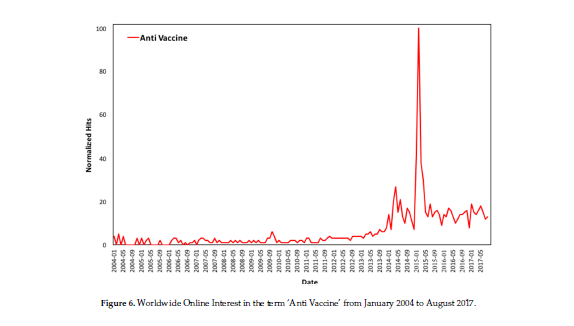
Among the findings shared in the results section of the paper: Overall, online interest in the term 'Anti Vaccine' significantly increased over the 13 years studied, with the average interest in 2017 being more than 10 times higher than what it was in 2004. One figure shows worldwide interest by country in MMR from 2004 to 2017; the country with the highest search volumes is Canada, followed by Australia and the United States (US). A peak was observed in January 2010, which coincides with Wakefield losing his medical license, while the peak over the whole examined period was observed in 2015, which could be attributed to the measles outbreak in Disneyland (in California, US). This peak is during the same time that the online interest for the terms 'Measles', 'Mumps', 'Rubella', and 'MMR' also peak.
The results show that statistically significant positive correlations exist between monthly measles cases and Google queries in the respective translated terms in most EU28 countries from January 2011 to August 2017. Furthermore, a strong negative correlation (p < 0.01) exists between the online interest in the term 'Anti Vaccine' and worldwide immunisation percentages from 2004 to 2016. The latter could be supportive of previous work suggesting that conspiracist ideation is related to the rejection of scientific propositions.
The researchers write, "As indicated by the results, online search traffic data could be proven a valid and valuable data source for governments and health officials for the monitoring of the behavior towards Measles and the Anti-Vaccine Movement. An interesting factor to be examined would be the degree of association of the Anti-Vaccine Movement with the overall recent political, social, and economic changes occurring in the EU at the moment. It has been suggested that advocacy and communication play a significant role in increasing Measles vaccination..., while the measure of mandatory vaccinations is also considered or already enforced in several European countries....However, governmental populism can negatively affect measures that should be taken in order to prevent disease spreading..., while websites with available information on 'vaccine myths' and anti-vaccination are more than the ones discussing the benefits of vaccination....All the above add to the important factor influencing individuals to dismiss information about the positive effects of vaccines..."
In conclusion, a worry: "Measles could be just the first of many to follow to exhibit such increase in reported cases, given that Measles require the highest immunization percentage out of the vaccine preventable diseases. Therefore, continuous monitoring is required for nowcasting the new cases that occur daily in relation to the variations in online interest, in order for the respective countries' Health Care Systems to be prepared, and for health officials to deal with reported cases in a timely manner and take the appropriate preventive measures, especially in countries and regions of high risk."
Big Data and Cognitive Computing 2018, 2, 2; doi:10.3390/bdcc2010002; and WHO press release, February 19 2018 - accessed on June 29 2018.
- Log in to post comments