










































COVID-19 Vaccine Rumors and Conspiracy Theories: The Need for Cognitive Inoculation against Misinformation to Improve Vaccine Adherence
International Centre for Diarrheal Diseases Research (Islam, Khan, Sarkar, Das, Harun); University of New South Wales (Islam, Kabir, Chughtai, Homaira, Seale); Khulna University of Engineering and Technology (Kamal); University of Saskatchewan (Kamal); independent scientific writing consultant (Southern); Mahidol University (Hasan); independent researcher (Sharmin); Khulna University (Roy)
"Herd immunity against misinformation and conspiracy theories is required to ensure herd immunity against SARS-CoV-2....The diverse amount of circulating COVID-19 vaccine misinformation could undermine the universal rollout of the COVID-19 vaccine candidates."
Historically, negative claims about vaccine effectiveness have affected vaccine uptake. For example, a boycott of the oral polio vaccine due to rumours that the vaccine caused infertility led to increased polio cases in Nigeria, Pakistan, and Afghanistan. Continuous exposure to social media and online anti-vaccine movement may influence people to share and communicate vaccine misinformation and conspiracy theories. Monitoring this media data is one method for tracking misinformation in real time and is a possible way to dispel misinformation and optimise vaccine acceptance. This study examined COVID-19 vaccine rumours and conspiracy theories circulating on online platforms, seeking to understand their context and to review interventions to manage this misinformation and increase vaccine acceptance.
In June 2020, a team of social scientists trained in infodemic management and epidemiologists was formed to review and collect COVID-19 vaccine(s) information circulating globally on online platforms including Google, Google Fact Check, Facebook, YouTube, Twitter, websites of fact-checking agencies, and websites of television and newspaper companies. The team collected the data between December 31 2019, the day COVID-19 was first reported in China, to November 30 2020.
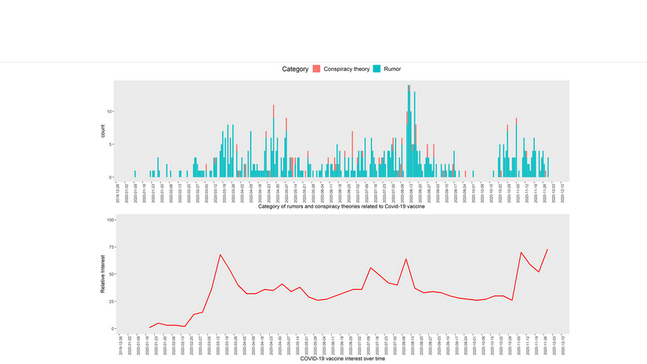
The surveillance identified 637 rumours and conspiracy theories related to COVID-19 vaccine in 24 languages from 52 countries. These items included news articles, social media narratives, online reports, and/or blogs that approximately 103.3 million people had liked, shared, reacted to with an emoji, or retweeted on social media. Of all the items, 15% (94/637) were reported in the United States (US), 13% (82/637) in India, and 12% (77/637) in Brazil. The African continent reported the least. Facebook was the most prevalent (61%) media, followed by Twitter (28.6%).
Of the 578 items classified as rumours, the researchers further classified them according to sub-themes:
- 39% (227/578) were related to COVID-19 vaccine trials, development, delivery, and access; of these, 76% (173/227) were identified as false/misinformation. For example, one commonly circulating rumour was that a Russian vaccine company omitted Phase 3 clinical trials for a COVID-19 vaccine. This claim provoked a lot of concern and criticism from the scientific community that the vaccine was not tested for effectiveness or safety in many humans, which might lead to global concern and vaccine hesitancy.
- 22% (125/578) were related to morbidity and mortality due to receiving the COVID-19 vaccine, the most common of which was that the COVID-19 vaccine would be a messenger Ribonucleic acid (mRNA) vaccine that could alter people's Deoxyribonucleic acid (DNA), subsequently turning them into a genetically modified human being.
- 9% (50/578) were related to safety, efficacy, and acceptance of COVID-19 vaccine - for example, that the natural survival rate from COVID-19 without the vaccine would be greater than the effectiveness of the vaccine.
- 6% (32/578) were related to COVID-19 vaccine reagents - e.g., that the COVID-19 vaccines were being produced with cells from aborted fetuses.
- 4% (24/578) were related to vaccine alternatives and necessity, with many posts claiming that the virus would go away naturally, with no need for a vaccine.
- 4% (23/578) claimed that people who were vaccinated for seasonal influenza were at higher risk of COVID-19 infection - e.g., the rumour that people had been injected with the virus during the administration of influenza vaccine during mass campaigns.
- 2% (14/578) were linked to political or economic interest related to the COVID-19 vaccine - e.g., that the vaccine was invented before the COVID-19 pandemic to advance vaccine sales.
Of the 59 items classified as conspiracy theories, 97% (57/59) were false. The most popular conspiracy theory circulating via the online platforms was that the COVID-19 vaccine could monitor the human population and take over the world.
Reflecting on the findings, the researchers note: "For a novel vaccine such as COVID-19 to be successful, the safety and efficacy of the vaccine and its wide acceptance needs to be ensured. As COVID-19 vaccine trials are advancing, so are numerous claims about COVID-19 vaccine safety and efficacy, some of which are false and misleading. While some national and international health agencies and fact-check organizations debunked these claims, the time gap between tracking and debunking misinformation, and its limited reach, may have left some populations vulnerable to vaccine hesitancy..." Thus, the researchers propose actions including:
- Development of interventions that target individual, community, cultural, and societal-level factors could help flatten the misinformation curve. Online platforms and broadcasting channels, including radio, television, and cable channels, can be used as mechanisms for promoting risk communication and community engagement.
- Websites that provide evidence-based information on COVID-19 vaccines should be developed and disseminated globally, as the use of such trusted sources of information have been found effective against misinformation and conspiracy theories.
- Considering that rumours may also spread offline (e.g., via word of mouth), social listening could be utilised to track offline messages. It has been recommended that people should fact-check with their family and friends. The World Health Organization (WHO) recommends a whole-of-society approach to reach diverse communities. Following a bottom-up approach, youth, religious leaders, community stakeholders, faith-based organisations, and schools can be engaged to co-design culturally compelling and context-appropriate risk communication and community engagement strategies. International and national health organisations, fact-checking agencies, and infodemic managers can help to identify correct information, and community ambassadors can diffuse and amplify this information in the community.
- Public health agencies could monitor and track frequently shared COVID-19 vaccine misinformation on social media. Risk communication targeting disease risks, the role of a vaccine in reducing COVID-19 related morbidity and mortality, and known side effects of a vaccine can be posted on social media to improve health literacy among the public. (As reported here, whether a person believes misinformation or not is dependent on his or her level of health literacy and risk perceptions.)
In conclusion: "Policymakers should consider these findings to devise risk communication and community engagement strategies to address these concerns with evidenced-based information. Additionally, topic modelling, artificial intelligence and machine learning technologies have the potential to track and analyze large media data in real-time; however, these technologies could be expensive for low-and middle-income countries."
PLoS ONE 16(5): e0251605. https://doi.org/10.1371/journal.pone.0251605.
- Log in to post comments