










































Fatal Journeys: Improving Data on Missing Migrants
"Despite all the media and policy attention given to reporting migrant deaths, data on the subject remains very limited."
From the International Organization of Migration (IOM)'s Global Migration Data Analysis Centre, this study on missing migrants worldwide provides a global review of existing data sources and illustrates the need for improvements in the ways that data on missing migrants are collected, analysed, and communicated. The volume, funded by the United Kingdom (UK)'s Department for International Development (DFID), focuses on how to improve data on missing migrants in order to prevent further deaths, and to enable the families left behind to learn more about the fate of their relatives.
The first chapter of part one of the Fatal Journeys volume 3 report provides an update of data on global migrant fatalities since 2014 and highlights the risks faced by migrant women and children. Data collected by IOM's Missing Migrants Project are used to present the known number and profile of dead and missing migrants in different regions of the world. For instance, since 2014, more than 22,500 migrant deaths and disappearances have been recorded globally by the IOM, but the real number is likely to be much higher, as many deaths are never recorded. In addition to the many non-gendered risks faced during migration, women are exposed to sexual and gender-based violence (SGBV) at every stage of the migration process, and are therefore at greater risk of human rights abuses and death during migration than men. Many risks experienced by irregular migrants are magnified for children; for instance, reports from migrants and asylum seekers on social media say that along the migration route through the Balkans, many migrants, including children, have been kidnapped and trafficked.
The following chapters highlight three key ways in which to improve the collection, sharing, and reporting of data on missing migrants:
- Making better use of potential new sources of data - One chapter of the report shows, for example, that the analysis of "big data" can provide a better understanding of the context of search and rescue operations in the Mediterranean. Here, Katherine Hoffman and her colleagues at UN Global Pulse and United Nations High Commissioner for Refugees show how big data can be used to complement other sources of data relating to missing migrants. (Because big data are often passively generated by people - when calling with a cell phone, navigating from one place to another, or "liking" a friend's social media post - they carry advantages including high frequency and large scale). Using the Automatic Identification System and Broadcast Warning data, Hoffman and her colleagues were able to study the precise location of rescue ships in the Mediterranean and to gather data about migrants and refugees on vessels in distress. This method provides a comprehensive picture of rescue efforts, whereas existing methods of data collection tend to focus on the most dramatic or severe incidents. Another new approach to data gathering has been to collect more data directly from migrants who may have witnessed a death. The report suggests, however, that such data needs to be interpreted with care. For example, such surveys may not be representative, and there is a risk of double-counting if different interviewees have witnessed the same death(s), and these are recorded as separate incidents.
- Better data to improve identification rates - The report shows that the percentage of missing migrants who are identified can vary a great deal by region. While in some cases the proportion of migrants identified can be as low as 25%, in other places, it can be nearly 75%. This suggests that much more could be done to gather data to increase identification rates. In chapter 4, Simon Robins reports on the findings of research conducted by the Mediterranean Missing Project, in which investigation of the formal and informal practices surrounding the management of bodies in Lesvos and Sicily provided insights into the major problems and gaps in knowledge faced by the families and the authorities. Closer contact with the families of missing migrants is also likely to generate more data about the profile of those who are missing and their reasons for embarking on their journeys. In chapters 5 and 6, efforts to improve identification rates in the United States and Central America are discussed that may be of relevance to other countries. A key message from these chapters is that much relevant data exists, but too often the coverage is fragmented and scattered between different authorities within countries. Few countries have national databases for missing migrants, and there is relatively little sharing of relevant data between countries in the same region. Developing mechanisms to share data more effectively could increase identification rates of missing migrants. There is also a lack of capacity for the identification of migrant remains in many county, regional, or city authorities. Furthermore, practices can vary within and between countries due to the absence of common identification standards used by forensic services. In response to this challenge, the Border Project (see chapter 6) created "forensic databanks" for missing migrants in several Central American countries. One notable feature of this initiative is that representatives of the families of missing migrants were invited to work with authorities to develop practices to increase identification rates.
- Communicating data differently - It is not sufficient to collect the data if they are not interpreted and presented accurately and in a balanced manner. Chapter 3 of the report focuses on the ways in which the media cover stories about missing migrants and makes recommendations on how current practices can be improved. It notes that current standards of media coverage vary widely, and the tone of the content ranges from humanitarian concern to reproduction of negative narratives about migration. The coverage of fatalities, in particular, "remains fixed in a media narrative of sensationalism and humanitarian disaster with too little focus on the lives of the victims and the context that drives them to seek escape from persecution, conflict or grinding poverty." Furthermore, often the information that the media provide about migrant fatalities is flawed, inaccurate, incomplete, or exaggerated. This is important from a data perspective, as a great deal of data on missing migrants is drawn from media sources. Aidan White and Ann Singleton address these issues and highlight the importance of communicating data about missing migrants sensitively and effectively. Clarity is needed, they say, about the responsibilities of authorities, researchers, and the media towards the victims and their families, as is a better understanding of the interplay between media reporting, public opinion, and establishment discourse. Questions include the following: (a) What are the ethical challenges of reporting on the missing and injured migrants, on the dying and the dead? (b) How can information be presented without dehumanising the victims or breaching their rights to privacy? (c) What are the specific responsibilities when reporting on children? A further challenge is reflected in the fact that "Gone are the days when only press photographers captured grief and terror with their lenses, or when journalists were the privileged gatekeepers to information about humanitarian disaster or social upheaval. In the digital age, bystanders can also snap shots of severed limbs and burned corpses with their phones and cameras and upload them directly online. At the same time, everyone with access to a mobile telephone and the Internet can report on and tell the story of human suffering without the filter of media professionals." That said, "even in the age of the Internet and with rapidly expanding access to online sources, trusted media play a vital role in bringing the world's attention to these events." Suggestions for media and journalists' groups include:
- Prepare concise guides to promote best practices for the reporting on refugees and migrants.
- Appoint specialist reporters with good knowledge of the subject to the migration and refugee beat and ensure they work closely with migration data experts.
- Provide detailed information on the background of migrants and refugees and the short- and long-term consequences of migration.
- Avoid political bias and challenge deceptive handling of the facts and incitement to hatred particularly by political, religious, or other community leaders and public figures.
- Respect sources of information and grant anonymity to those who require it most - particularly those who are vulnerable and most at risk.
- Establish transparent and accessible internal systems for dealing with complaints from the audience over coverage of migrant and refugee issues.
- Review employment policies to ensure newsroom diversity with reporters and editors from minority communities.
- Provide training for journalists and editors covering everything from international conventions and law to refugee rights and what terms to use while covering refugee stories.
- Monitor coverage regularly, organising internal discussions on how to develop and improve the scope of migration coverage.
- Manage online comments and engage with the audience to ensure that migration stories are not used as a platform for abuse or intolerance.
- Support national structures for independent regulation or self-regulation of journalism, such as press councils.
- Engage with the media audience and connect with migrants - Refugee groups, activists, and non-governmental organisations (NGOs), many of which provide vital information for media, can be briefed on how best to communicate with journalists, and media can explain to the audience their policies and editorial approach that may encourage readers, viewers, and listeners to contribute useful additional information. Media could also play a role with migrant and refugee support groups in establishing monitoring projects to track missing persons.
- Support efforts to identify missing migrants - e.g., media can assist the IOM's aforementioned Missing Migrants Project. Training seminars on migration reporting should focus on the importance of this issue and how media can help to strengthen national initiatives to compile information on lost or missing persons who may be among the unidentified victims of migration disasters elsewhere. Such work can also be strengthened by encouraging media support groups to join networks campaigning for better quality in collection of data, improved identification of the dead, and support to families of the missing.
- Challenge hate speech - just because someone says something outrageous doesn't make it newsworthy.
- Secure access to reliable information and facts by, for example, meeting regularly with police and State authorities and agencies to ensure journalists have safe conditions in which to work and access to the information they need.
Looking ahead, the inclusion of migration in the United Nations' 2030 Global Agenda for Sustainable Development and the commitment of States to promote safe, orderly, and regular migration require improved data on indicators of "unsafe migration". Improving information and reporting on who these missing migrants are, where they come from, and above all, when they are most at risk, is crucial to building a holistic response to reduce the number of migrant deaths.
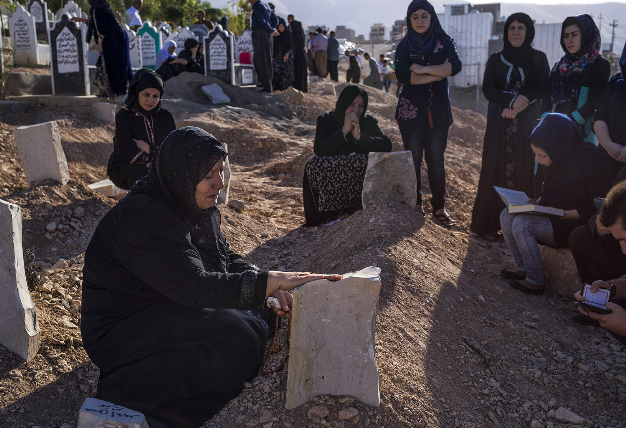
Ethical Journalism Bulletin - 26 September 2017; IOM Press Release, September 11 2017 - accessed on September 27 2017; and email from Julia Black to The Communication Initiative on September 28 2017. Image caption/credit: "The family of Shwan Hussein, 23, a Kurdish migrant who died while being smuggled to Europe, visits the cemetery." © NOOR 2015 (Photo: Yuri Kozyrev)
- Log in to post comments