










































The Media of Pakistan: Fostering Inclusion in a Fragile Democracy?
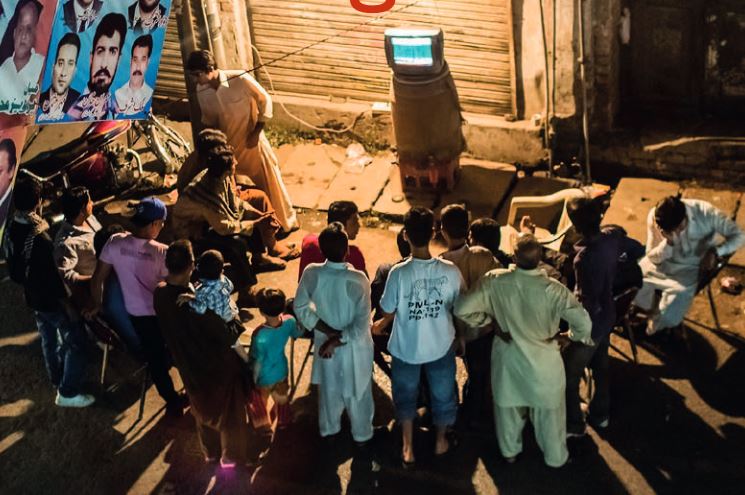
Freelance journalist and media researcher (Yusuf), iMedia (Schoemaker)
"...[M]edia's expanded gatekeeping function is its greatest contribution to Pakistan’s democratic transition."
This policy briefing, published by BBC Media Action, examines the role of media as a driver of inclusion and accountability in the democratic transition of Pakistan. It is based on research done from November 2012 - January 2013 using in-depth interviews conducted with Pakistani media professionals, analysts, policy-makers, and members of the telecommunications industry, as well as focus group discussions in Urdu conducted simultaneously in all regions with multiple moderators. [Footnotes removed throughout by the editor.]
From the Executive Summary: "The Pakistani media's democratising function is constrained by its historic role as a state-building tool. The media remains vulnerable amid on-going threats to media professionals and the limitations imposed by the industry’s financial model, which must rely heavily on advertising revenue. The government, military, intelligence agencies, judiciary and non-state actors such as militant groups exploit this vulnerability as part of their competition for political power. The geographic imbalance of the broadcast media in Pakistan further limits the industry’s potential to play a truly national role."
This briefing shows how a changing media landscape in Pakistan is increasingly giving voice to populations through: regional-language television and FM radio stations; a proliferation of new, independent, privately-owned broadcast media outlets; and emerging social media. It contains six parts: part 1 explains the historical context; part 2 considers the competing legacies of media as state control of national discourse and media as a platform for civil democracy; part 3 illustrates the privately-owned media’s role as gatekeeper; part 4 documents some of the challenges - political, security-based, and economic - that constrain the media's ability to hold the Pakistani government to account; and parts 5 and 6 lay out some future challenges for the sector, as well as issues that international actors might consider addressing in order to support the country’s media, enhancing the democratising possibilities of the media industry.
Civil agitation beginning in 2007 with the "lawyers' movement" and the loosening of ownership laws in 2007 fueled media expansion: 30 new television channels were licensed in 2008, compared with 17 in 2007 and three in 2006. The report proceeds to examine the following 3 media functions:
- gatekeepers: the media can ensure that all views - particularly those of minorities and marginalised groups - are included in public dialogue;
- watchdog: the media can protect the public interest by holding the powerful to account; and
- agenda-setters: the media can act as a platform for public debate by framing social issues and shaping public opinion.
In a June 2011 Pew Research Center poll, 76% of those surveyed in Pakistan believe that the media has a good effect in the country - showing a high level of confidence in the media's gatekeeper role. Television programmes give voice to urban populations, but rural respondents continue to rely on direct, personal contact with district politicians and provincial assembly members. Sparsely populated areas are called "media dark" - both because of limited access to media and because there are few media personnel reporting from these regions.
Print publications are declining in numbers and importance, from 1,820 in 2007 to 749 in 2011, including both English and Urdu papers, in a country with a 50% literacy rate. Regional television channels and FM radio stations broadcasting in local languages are increasing in popularity, coinciding with the processes of political decentralisation and strengthening of provincial autonomy. Pakistan has enabled the liberalising of media to reflect their ethnic, linguistic, and political diversity (e.g., Sindh, Saraiki, and Pashtu), increasing the pluralism of political opinion. Focus group interviews showed that regional media were more trusted and felt to be more representative of local concerns.
Social and mobile media are increasingly competing with the mainstream media's gatekeeping and agenda-setting roles in Pakistan through mobile phones and the internet. Facebook, for example, includes 4% (8 million) of the population but added a million users in January of 2013. Mobile phone use is growing even faster: "Some reports suggest that over half of regular radio listeners listen through their phone, while some radio stations report receiving more than 100,000 text messages per month....In focus group discussions conducted for this briefing, the majority of participants with access to social media selected this medium as the preferred means for having their voices heard." Marginalised groups are using social media to drive the media agenda, for example, using "tweets to al Jazeera's live Twitter feed, prompting extensive coverage by the international broadcaster."
The model of privately owned media shows the influence of money on the direction of media development. This influence includes, for example, advertising revenue from the government during election cycles. Prohibitive licensing costs are among the limiting financial factors. Such costs cause media owners to be reticent about being blocked by censorship and make them more susceptible to coercion and less likely to allow journalistic freedom among staff. This reticence due to financial vulnerability is damaging media credibility. The researchers discuss the limitations caused by corruption and censorship on media development and name the internet as the freest space identified in the research for public debate. However, cyber censorship, as well as intimidation of journalists, exists in Pakistan.
Challenges include the following:
- Public disillusionment is occurring due to the media’s perceived ineffectiveness as a driver of change;
- Media decentralisation may bring with it political fragmentation and polarisation; and
- There are also concerns that, together, privately-owned media and social media will exacerbate social polarisation by empowering extremist voices.
Policy recommendations include:
- Support the Pakistani media in strengthening a politics of inclusion by: building the capacity of regional-language broadcast media; strengthening the online presence of pro-stability, inclusive, and democratic media; countering "hate speech" and divisive and exclusionary online content; promoting digital literacy across Pakistan; and improving the quality of Pakistan’s media outputs.
- Convene a donors’ working group for the purposes of increasing the inclusion of media content analysis and strategy in donor country assessments, work plans, and monitoring and evaluation.
BBC Media Action website, September 16 2013.
- Log in to post comments