










































Men and Women and Merely Players
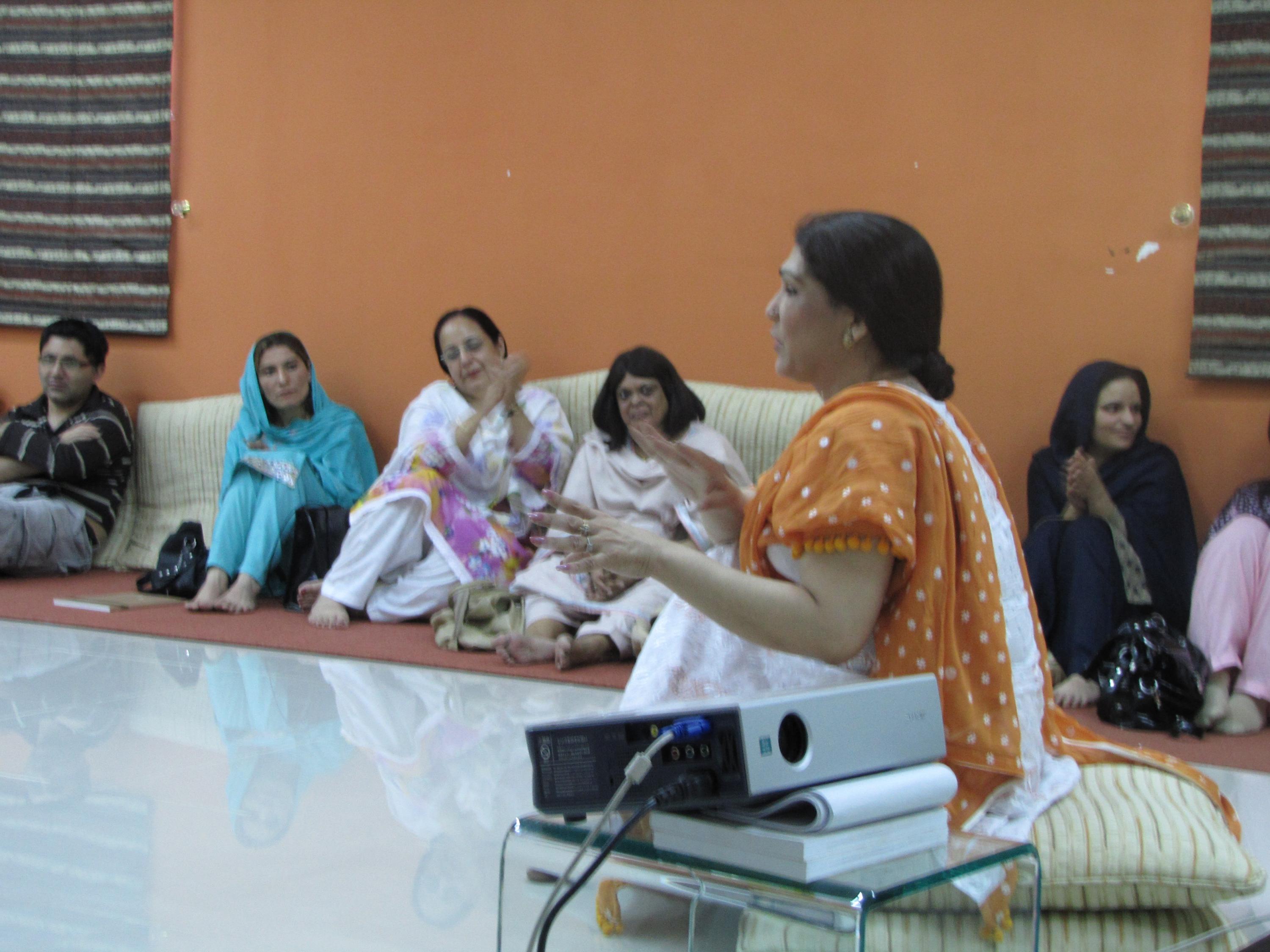
"All the world’s a stage" for the transgender community of Pakistan. The role is assigned by a cursory glance at a traffic light: “jester”, “oddball”, possibly “a morally degenerate sex worker”. The general public looks no further and the flat character seen meandering through the traffic, vending prayers, accepts the shapelessness of the umbrella term, “hijra”.
This holds until the general public encounters an individual such as Almas Bobby, President of the Pakistan Shemale Association. One of the pioneers of transgender activism, Almas has played a prominent role in bringing about the formal recognition of the “third gender” by the Supreme Court.
Known as a “Guru” in the transgender community, Almas has been very clear when it comes to putting things in perspective for the media, government and civil society.
“Men are men, women are women, we have our own identity,” she told anchor-person Mubashar Lucman on the national television channel, Express News. Her candid interview made waves in the country, suddenly bringing prickly taboos into public discourse and forcing attention on people who for decades have existed at the fringes of Pakistani society.
Whether media attention has been a cause or consequence of the legal victory, it has in turn evoked interest from many quarters. There has been, for instance, fresh discussion in the blogosphere regarding the various kinds of individuals who are summarily dismissed as “hijras”. They may be either physically different or, as Almas puts it, cannot help the spirit that they are born with.
“Is there a technical fault in the child, then? Is it a fridge or TV?”
For the development sector, she has acted as a reminder that the gender discourse is not confined to women. In April 2011, Almas Bobby had her first direct audience with a range of guests from the development community.
What was most striking about Almas during this interaction was her remarkable poise. She was a star performer who knew exactly where to direct a flirtatious wink or extravagant compliment and cash in on her persona. But when given the floor for the highly anticipated Q&A session, she morphed into a powerful story-teller who held the senior management in thrall.
Beginning with her personal story, she opened a portal into a tight-knit community that has built a parallel world with complex filial relationships among the “sahelis” (female friends). When they put on their lipstick and enter the less accepting world, the luckier ones are hired as professional entertainers, while the others find themselves begging alms at the aforementioned traffic light. She then traced the evolution of awareness, following the success of protests against institutionalised injustice. As for the way forward, her agenda points were clear: recognition and acceptance of the third gender; promotion of decent livelihoods; and access to rights of inheritance.
If these demands were to be accepted as valid and true, those involved with legal and economic empowerment would have their work cut out for them. What is less easily delineated is the role of the media. It is one thing to say that the free press is the most powerful medium for creating a more tolerant society. The truth is it can only be powerful as long as public “buy-in” can be ensured.
In that sense, Almas’ media-savvy ways have at least broken the ice. She can talk politics, religion and society with dry humour and a flair for drama which holds the attention of diverse target audiences, till she gets her point across.
(“The Taliban have never given us any trouble. Who ever heard of a bomb in the Red Light Area? They only have blasts in mosques, Imam Bargahs, and gatherings for peace.”)
While this may not be the most conventional development-oriented approach, it could be the first step towards better integration. If the media has so far been lacking nuance and understanding in its projection of the third gender, the way of rectifying this would be actual engagement with living, breathing, dimensional people. Eventually, this could lead to the removal of the stigmas attached to the community, so that alternate forms of employment can become available on a practical level. In the long run, as Almas envisions, civil society could even play a pivotal role in supporting reconciliation of outcast transgender individuals with families.
“It is only the first drop of rain,” she smiled as she talked about her Supreme Court statement. There can be little doubt in her ability to summon a storm.
- Log in to post comments