










































Positive Deviance: An Asset-based Approach to Improve Malaria Outcomes
Malaria Consortium (Shafique); Consultant (George)
"We learned from the real role model; he lives with us, sits with us and tells us what exactly he did to prevent malaria. We can easily understand and follow his behaviour." - Female community member
This learning paper describes and evaluates a pilot project in northwest Cambodia that used positive deviance as a method of behaviour change communication (BCC) for malaria control. Positive deviance is a behaviour and social change approach that helps identify existing model behaviours within a community that can be shared and amplified by the rest of the community. The project discussed in this learning paper focused on mobile and migrant workers and resident communities in 3 villages in Sampov Luon district, northwest Cambodia. This work was carried out by Cambodia's National Centre for Parasitology, Entomology and Malaria Control (CNM), with the technical support of Malaria Consortium and funding from the Bill & Melinda Gates Foundation.
The positive deviance approach was conducted in two phases. In the first phase, which was carried out in one week (August 2010), community dialogues were established with village leaders, volunteers, teachers, and the mobile and migrant population, and qualitative methods were used to understand the normative behaviours around malaria prevention and control. (For instance, 6 focus group discussions (FGDs) and 13 in-depth interviews were carried out with community members, farmers/landlords, and mobile and migrant workers. Mosquito nets and hammock nets were used for demonstration in the FGDs and in-depth interviews.) Positive deviant individuals (role models) from the community were identified during this phase: Despite sharing the same resources and living or working in the same community, they showed healthy behaviours and outcomes with regards to malaria prevention and control.
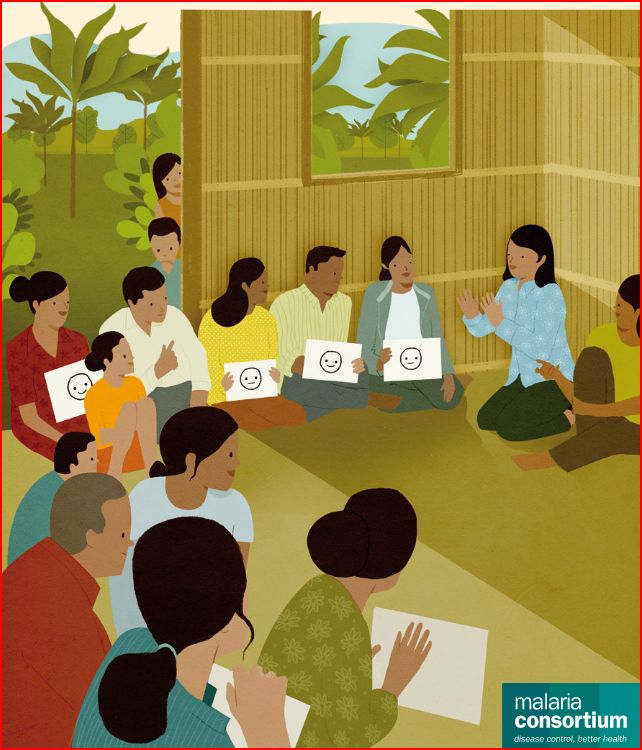
In the second phase, which was completed over a 6-month period, interactive ways were implemented to share the role models' behaviours with other community members (example behaviour: wear long-sleeved clothes and sleep under the long-lasting insecticide treated mosquito net every night). Because it was difficult to find individuals who modelled all the positive malaria prevention and health-seeking practices, different people were chosen to model different behaviours. "This process encouraged community participation, established a community dialogue, identifying the positive strategies used by members of the community. It led the way for acceptance and ownership by the community." Specifically: "A community feedback and action planning session then shared the findings and mobilised and motivated the community. Around 50 participants from all parts of the community, and including health professionals, attended. Some positive deviance behaviours were shared with the audience, asking three couples from the community to do the role plays on identified behaviours. The community members said they enjoyed the role plays and promised to follow the behaviours highlighted in the role plays. In another activity, the positive deviance behaviours were written, by topic, on flip chart and were placed in a cardboard box decorated as a positive deviance house. Participants were asked to take out a flip chart paper through the door and read the behaviour. Each behaviour led to a general discussion among the participants. At the end, an action plan was prepared to explore ways to enable more families to adopt these behaviours."
At the end of Phase 2 in March 2011, a positive deviance seminar was held. It was a community seminar involving more than 300 people, involving key decision makers from the community, national programmes, and the community to celebrate the project's achievements. The event featured a question-and-answer session designed to engage community members and to assess and correct their understanding on key malaria issues, as well a song and malaria poster competitions. This event was a strategy for symbolically handing over the project to the community.
In March 2012, qualitative and quantitative surveys were carried out to assess the community's views of the project and to see the extent to which there had been lasting behaviour change with regards to malaria control in the area. Qualitatively: "For instance, a network of volunteers was successfully built with individuals from all parts of the community continuing to demonstrate the positive deviance behaviours. The sustainability of the programme now seems sure, due to the levels of community ownership. Positive deviance informal sessions were still taking place a year after the project had formally ended." The quantitative survey showed an increase in knowledge of malaria prevention methods and an increase in knowledge of transmission modes - especially knowledge of vulnerable groups, i.e., forest-goers. Furthermore, the project was found to have improved health-seeking behaviour such as consulting village malaria workers (VMWs) or visiting the health centre for malaria diagnosis and treatment.
The report shares specific details about what worked well, lessons learned, challenges, and conclusions and recommendations. Sample insights include:
- "The positive deviance approach could be applied in other areas such as public health facilities, private clinics and private health providers to improve the use of malaria services.
- The positive deviance approach can be applied on the village volunteers to improve their performance, motivation and retention.
- Positive deviance role models and their behaviours can be leveraged through electronic media, such as provincial and national radio and TV. This will help scale-up the approach and reinforce the messages given by the positive deviance volunteers at community level.
- The provincial and local health facility staff should be trained to replicate or scale-up the positive deviance approach at provincial or district level.
- Community and community-based individuals such as village health volunteers and health centre staff should be given a lead role when positive deviance is implemented at community level."
Malaria Consortium website, May 1 2014; and email from Michelle Davis to The Communication Initiative on May 30 2014.
- Log in to post comments