










































Utilising the Positive Deviance Approach in Netherlands to Enhance Psychological Resilience amongst Adolescents Vulnerable to Depression and Anxiety
"do some schools, against all odds and with access to no additional resources, perform better than other schools?"
This Dutch project on mental resilience at lower vocational training (VMBO) schools in Rotterdam Municipality employs the positive deviance (PD) approach to social change, a method that enables communities to discover the health wisdom they already have and to act on it. It is an initiative developed by the Netherlands-based Center for Media & Health (CMH) in collaboration with the GGD Rotterdam Rijnmond, the Trimbos-Institute and the United States (US)-based The University of Texas at El Paso.
The premise of PD is that, in every community, there are certain individuals or institutions whose uncommon behaviours or practices enable them to find better solutions to problems than their peers who have access to the same resources. The behaviours and practices of these individuals or institutions are "positive" because they are doing things right to achieve the desired outcomes and "deviant" because they engage in behaviours and practices that most others do not. A PD inquiry is thus couched in a paradigm that, instead of focusing on what is not working (the deficits), focuses on what is working (the assets). In so doing, it capitalises on the existing knowledge of positive deviants within a community
Although various depression treatment and prevention programmes have been developed for adolescents in the Netherlands, those with a lower socioeconomic background and from minority immigrant groups are not adequately reached. To that end, this research project focuses on the positive deviants at VMBO schools in Rotterdam. This type of education, which lasts 4 years (from the age of 12-16), combines vocational training with theoretical education in languages, mathematics, history, arts, and sciences. For identifying the schools which represent a positive exception, the central PD question organisers asked was: Are there VMBO schools in Rotterdam which:
- have more than 120 students,
- have more than 50% students with an immigrant background,
- are situated in a socio-economically deprived neighbourhood,
- are not part of the healthy schools programme, nor have access to any other special resources, and
- are highly mentally resilient (based on aggregate data compiled in schools through the Strength and Difficulty Questionnaire, or SDQ)?
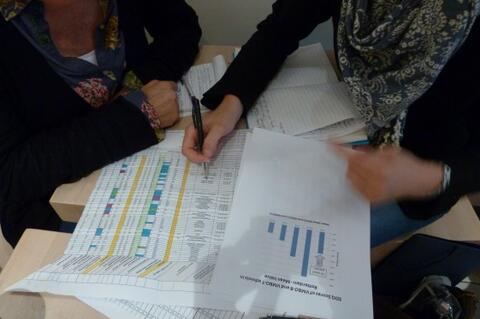
Based on the Youth Monitor Research (employing the SDQ), the CMH and partners identified 8 schools (out of 52) which scored high in terms of mental resilience (i.e., SDQ score of 10 or less on the data scale). From those 8 schools, 3 schools were identified as PD schools, because they also fulfill the rest of the PD inclusion criteria (more than 120 students, 50% immigrant background, situated in a deprived neighbourhood, no extra resources).
In the next step, trained PD facilitators helped the community of the PD schools (e.g., managers, teachers, concierge, school nurses) to identify the uncommon but effective institutional and individual practices, and are working with them to make them visible and actionable. In a PD inquiry, the community self-discovers what works and develops a plan to promote their wider adoption. In this sense, PD is led by internal change agents who present the social proof to their peers that better outcomes are possible. VMBO schools in Rotterdam that score low on mental resilience are being invited to learn more about the effective practices and behaviours of the PD schools and students. Preliminary results identify the following PD practices as contributing to higher levels of psychological resilience in the PD schools:
- Students are welcomed by the school concierge at the entrance of the school in the morning.
- Doors (teachers' offices, classrooms, concierge office) are open to all students at all times.
- Tardiness and absenteeism are prevented in creative ways, empowering the students to take responsibility for their actions.
- School mentors call parents on the phone not only when there are problems, but also if a student does something good, strengthening the communication loop.
For more photos and clips of the project, click here.
Mental Health, Youth
In the Netherlands each year, 114,000 adolescents (ages 13-17) suffer from anxiety disorders and 37,000 suffer from a depression (Hollander et al., 2006). Increasing psychological resilience can enable young adolescents to better deal with the stresses and anxiety that are (a normal) part of life. Psychological resilience refers to an individual's capacity to withstand stressors and not manifest psychological dysfunction, such as mental illness or persistent negative mood. Although various depression treatment and prevention programmes have been developed for adolescents, those with a lower socioeconomic background and from minority immigrant groups are not adequately reached (Hamer, 2010).
Positive Deviance: Interview with Martine Bouman, Center for Media & Health from Center for Media & Health on Vimeo
Center for Media & Health in collaboration with the GGD Rotterdam-Rijnmond, the Trimbos-Institute and the University of Texas at El Paso. Funded by ZonMw (The Netherlands Organization for Health Research and Development).
Emails from Dr. Sarah Lubjuhn to The Communication Initiative on October 21 2013 and April 25 2014.
- Log in to post comments