










































Science Journalism COOPeration (SjCOOP)
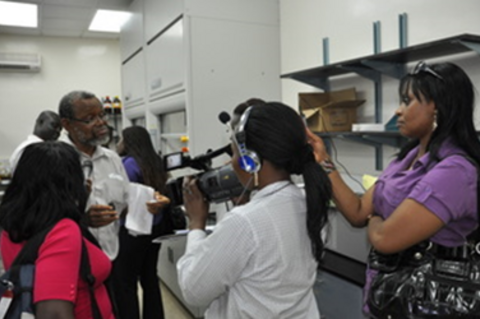
SjCOOP is built to provide journalists with additional new skills, as well as review the basic skills in the reporting of science and technology. Training of journalists is achieved at a distance while journalists remain active in their normal working environment. The journalists benefit from the advice and support of mentors who are experienced science journalists from within or outside their regions. These mentors provide a full range of advice and support, from help with specific reporting assignments to career development and international freelancing. Mentors and mentees meet face-to-face at least once a year.
The initial SjCOOP was implemented from 2006 to 2009. It simultaneously offered training in their mother tongue to English- and French-speaking African journalists as well as Arab-speaking journalists. Eighty-one journalists participated in the programme. The project also established 8 associations of science journalists which were then twinned with European and North American associations. SjCOOP journalists created 5 new science television programmes, 6 new radio science programs, and 7 new science beats in newspapers, magazines, and agencies. Fifteen of the journalists were promoted, 17 started freelancing internationally, and, all together, they collected more than 44 prizes and awards. Another 15 journalists from Africa, the Middle East, Europe, and North America became experienced in the training of science journalists as mentors.
The SjCOOP follow-up project will again be multilingual and simultaneously offer training in the Arabic, English, and French languages. The training will address issues that are common to the Africa and Middle East contexts, such as a shortfall of competent journalists needed to cover scientific and technology issues, lack of interest from editors for science and research, and skepticism of scientists and policymakers towards the media.
SjCOOP will train 60 journalists in the reporting of science and 15 experienced science journalists as trainers in science journalism in the African anglophone and francophone countries as well as in the Arab countries of North Africa and the Middle East. It will be implemented with the goal of reinforcing regional and local structures in the delivery of training in science reporting. A young science communication organisation based in Africa, Development Communications (DEVCOMS) Network, will be a partner of the WFSJ in implementing the project. Regional and national associations of science journalists in the Arab World and in Africa will gain experience and eventually implement their own training activities from start to end.
SjCOOP will put in place and reinforce ten associations of science journalists that will provide sustainable support to these 60 journalists and 15 trainers. Science journalism basics will be addressed by tutoring in the online course in science journalism that was developed during the first phase of SjCOOP.
Science, Technology, Media
SjCOOP mentee Violet Otindo's TV story, "The price of protection", first broadcast on Kenyan television (channel K24) on February 25 2011, revealed that there was an acute shortage of free condoms in some parts of the country, particularly in the northern Isiolo region. This situation had apparently led to unheard of practices for protection against HIV/AIDS like washing and reusing condoms, or using plastic bags instead of condoms. A few days after Otindo's broadcast and ensuing local media reports, the Kenyan government held a press conference admitting there was a condom shortage and announced they had appealed for emergency funding to purchase 45 million condoms. "This announcement triggered national and international media attention, and fuelled intense public debate. Within days of the government's announcement, the Red Cross kicked in with an emergency shipment of condoms. Kenyan government administrators admitted that the media hype speeded up the government's response to mitigate a serious public health issue." Violet Otindo credited her mentor's support through the SjCOOP programme and the financial aid from Internews in helping her realise this story. According to WFSJ, "media coverage is essential in bringing acute problems in the public domain, as SjCOOP evaluators of Violet Otindo's story and its impact have concluded. It can be done with comparatively small means, a lot of dedication and enthusiasm, professional advice from mentors and colleagues, and cooperation among journalists."
Funded by: International Development Research Centre (Canada), Department for International Development (UK), and the Dutch Ministry of Foreign Affairs (DGIS).
WFSJ website on May 27 2011 and September 20 2012.
Comments

I WANT TO BE TRAINED
Dear friend , i would like to know more about training so i would like to get connected Please let me know how it can manage.I am from Kinshasa /DRC
- Log in to post comments