











































Vidura: A Journal of the Press Institute of India - April-June 2020 Edition
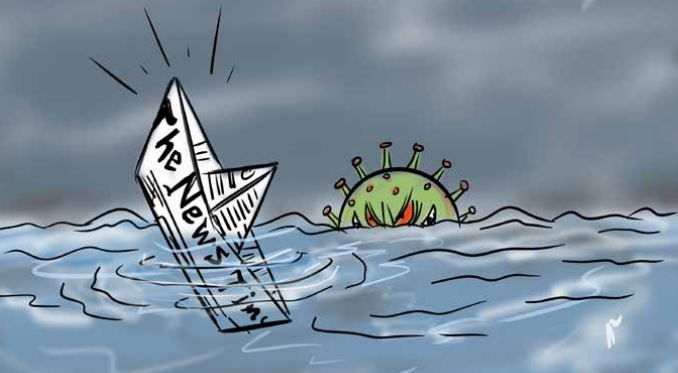
"The COVID-19 lockdown has battered and bruised journalists as never before." - Usha Rai
Published by the Press Institute of India (PII) since 1963, Vidura is a quarterly journal that focuses primarily on pertinent issues relating to the media. The April-June 2020 edition explores journalism in India in the context of the COVID-19 pandemic.
Sashi Nair, Editor, introduces the edition by explaining that, across India, various newspapers have closed down, and many journalists have either lost their jobs or are facing hefty wage cuts. Many have been asked to go on furlough, or leave without pay in many media establishments. Among other actions being undertaken to address these impacts: The National Alliance for Journalists (NAJ), the Delhi Union of Journalists (DUJ), and the Brihanmumbai Union of Journalists (BUJ) jointly filed a public interest litigation (PIL) in the Supreme Court on April 16 2020, challenging the job losses and wage cuts in the media. The PIL has asked the Union Government, the Indian Newspaper Society, and the News Broadcasters Association to ensure that media employers do not misuse the lockdown for arbitrary action against employees.
In the lead story, "Journalists Battered and Rattled across the Media Spectrum", Usha Rai reports on other media-related impacts and responses. For example, on May 26 2020, the South Asia Media Defenders Network (SAMDEN), which is anchored in the Commonwealth Human Rights Network and has on board 60 media professionals across South Asia, expressed its concern over the future of the media industry, which has been battered on 3 fronts: concerns about health safety at a time of being an "essential service" on the frontline of the crisis; job insecurity in the light of wage cuts and dismissals as the media industry takes a hit during COVID-19, and physical intimidation and arbitrariness facing media workers internationally. In terms of responses, for instance, in the wake of pandemic-related closures and shutdowns, the Network for the Protection of Journalists Rights (NPJR) issued 4 sets of guidelines for journalists, which have been translated into various languages and widely disseminated. The first guideline says if you are facing job loss, wage cut, furlough, or "closure", keep documents such as your appointment letter handy.
Examples of other contents in this edition that are focused on media, communication, and development issues specifically include:
- "The Novel Coronavirus: Lessons for Us to Learn", by Sakuntala Narasimhan - "Over the past century, humans have arrogantly appropriated the right to criminal profligacy in the use of natural resources, causing enormous ecological and environmental damage, much of it irreversible. All the riches of the world cannot buy or save lives and millions of dollars in the bank cannot bribe an invisible virus to retreat, she points out..."
- "The Rhetoric and the Reality" - "Sakuntala Narasimhan tells how poverty, illiteracy, lack of awareness and pervasive corruption from the lowest to the highest levels make for a deadly combination..."
- "Gender Implications and Challenges for Community Intervention", by Vibhuti Patel - "On March 24 this year, the Government of India announced the nationwide lockdown....The emergency measure has had dire implications for the vulnerable populations... - for 94 per cent of the workforce in the informal sector, women-headed households which are the poorest of the poor, persons with disability, the homeless, lonely and elderly, the socially stigmatised transgender community, sex workers, persons with disability, prisoners, and inmates in overcrowded shelter homes..."
- "The Need to Respect Dignity and the Rights of All" - "The National Alliance for Maternal Health and Human Rights had sent recommendations to India's Prime Minister asking him to take necessary action to balance between mitigation and containment measures, and the prevention of potential human rights abuse in the control and management of the COVID-19 pandemic. The letter is reproduced here..."
- "Adapting to Behavioural Change in the Time of Lockdown", by Pradeep Krishnatray - Some of the topics covered: risk perception and community engagement.
- "Lockdown Blues - More Lessons for Us to Learn", by B.S. Raghavan - "...[G]oing overboard and becoming a victim of anxiety neurosis or fear psychosis is not such a good idea."
- "And Now, A Radical Pedagogic Shift, A New Path", by Arpita Maitra, who examines the ramifications of the increased dependence on digital technology for academic activities...
- "Measles - A Metaphor for a Deepening Crisis of Mistrust", by Pradeep Krishnatray - "With mistrust growing among experts and the population, vaccine hesitancy is not going to die anytime soon. In this article, Pradeep Krishnatray explains how Samoa saved precious young lives by inoculating 90 per cent of its population against measles in less than a month..."
- "Newspapers in a Tailspin, Mobile Theatres See End of Road", by Nava Thakuria - "Rumours, which have since been dismissed by the WHO [World Health Organization], that the dreaded COVID-19 can spread vianewspapers, have brought regional newspapers in the Northeast of India to an alarming pass. Nava Thakuria, while analysing the situation, also looks at mobile theatre groups desperately struggling to survive..."
76
Email from Sashi Nair to The Communication Initiative on June 23 2020. Illustration: Arun Ramkumar
- Log in to post comments