










































World Sight Day: using radio to reach out
Author: Aveseh Asough, October 9 2015 - We were already a few hours into our production training workshop in Benin City in south Nigeria, when a shy, young man arrived in my training room, apologising "Madam, I am so sorry I am late."
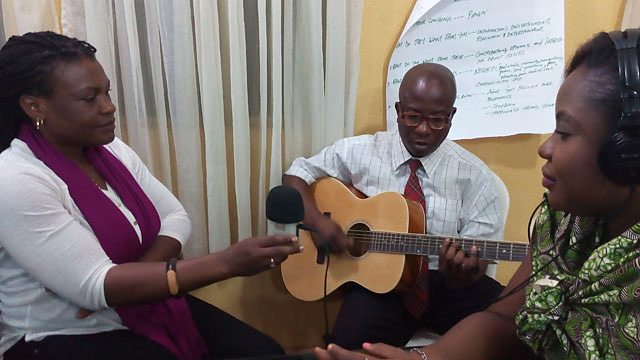
I soon learned that this was Timothy Osemwegie. Born with good sight, Timothy became blind at the age of three but didn’t let that stop him becoming a presenter on both radio and TV at the Edo State Broadcasting Service here in Nigeria.
Timothy loves his job - and his guitar. But, he told me, faces many challenges, including in the radio studio. He needs someone to help him select and play music when he is presenting but sometimes, “You tell them to cue track one and they cue track eight,” he said with a giggle.
Training for all
The training we run for our over 80 radio stations in Nigeria is always highly practical with lots of exercises that get everyone up from their desks and moving around. We particularly focus on team-working and it was noticeable that all too often Timothy was left out by his colleagues and not involved in the team’s work.
So I asked the team to congregate around where Timothy was sitting and take the task a little more slowly so he could also listen and make his contribution. They took this on board and continued to do so for the remaining days of the training.
Real results
For a long time now, BBC Media Action in Nigeria has set out to engage people with disabilities at all levels of our work.
For example, our health radio programme Ya Take Ne Arewa (What’s happening up north?) is currently featuring Samanja, a famous blind movie star from the north of Nigeria.
Another of our projects, meanwhile, recently had a terrific result. Tosan Akinwale, a radio producer who is paralysed from polio, attended our training and learned how to produce what we call ‘Town Hall meetings’, where radio stations bring together local people to ask their leaders questions on air.
After our training, Tosan returned to her home station and produced a programme where almost three quarters of the audience asking the questions were people with special needs. She told me that she was thrilled to learn "what I can do to help people like me to know their rights and to participate in how our society is run".
Learning from our trainees
At the end of the training, I asked Timothy how we could improve the experience and he had a lot of ideas, including creating audio and Braille material for trainees.
And as one of our team’s priorities this year is to train more people with special needs from across Nigeria, we're asking Timothy and another blind producer from Federal Radio Corporation of Nigeria to join our radio production team as interns next month. We can’t wait!
Click here to access this BBC Media Action blog and related links on their work in Nigeria.
Image credit: BBC Media Action
Contact:
BBC Media Action
BBC Media Centre, MC3A, 201 Wood Lane
London
W12 7TQ
United Kingdom (UK)
Phone: 44 (0) 20 8008 0001
Fax: 44 (0) 20 8008 5970
Media.action@bbc.co.uk
- Log in to post comments