











































Malaria Control in Cameroon
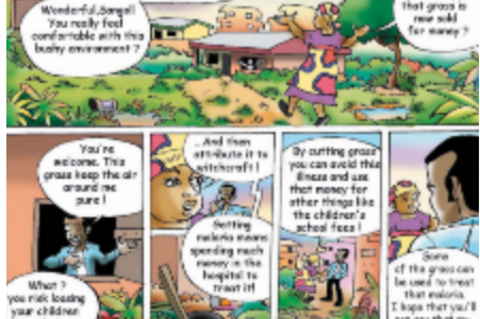
Between 2009 and 2011 the Fobang Foundation (FF) ran a programme in Cameroon to promote malaria prevention by explaining the biological basis of the disease and educating the population on better control methods. The programme worked at the national and policy level to improve information collection and dissemination, and at the grassroots level to promote awareness and action through comics, radio, schools clubs, theatre, and a vocational centre.
According to the Fobang Foundation, in 2006, it became clear that Plasmodium falciparum was resistant to amodiaquine and that the Anopheles mosquito was resistant to pyrethroids. In 2007, the National Malaria Control Programme (NMCP) decided to reorient towards greater community participation in order to mitigate the difficulties it was having scaling up its interventions with insecticide-treated mosquito nets, the intermittent preventive treatment (IPT) of pregnant women with sulfadoxine pyrimethamine (SP), and the use of Artemisinin-based combination therapy (ACT). According to FF there was also a general lack of information or the information that is disseminated is not culturally relevant.
At the national and policy level the programme coordinated a biennial Malaria Report for Cameroon by helping the National Malaria Control Programme develop questionnaires, collect and analyse information from the provinces, and monitor sites and organisations involved in malaria prevention. To promote effective malaria prevention in communities, the programme adapted training kits to educate at-risk groups, and conducted community-based awareness and prevention activities. The key activities were as follows:
- Research and capacity build-up - FF worked with the 'National Malaria Control Programme' (NMCP) and the Cameroon Coalition Against Malaria (CCAM) to gather information in order to create a complete picture of the malaria situation in Cameroon. This included malaria indicators in a number of important regions (in North-West, South-West and Central Cameroon as well as in the Adamawa regions). The focus was on children under five and pregnant women.
- Cultural health education - FF produced a malaria manual and co-sponsored the biweekly report 'About Malaria’, which also contains a comic strip on preventing malaria. The Radio Health International project enabled information about malaria to be broadcast over the radio.
- School Health Clubs (SHC) - School health clubs received sponsoring for project activities that are part of the Community Outreach Malaria and HIV Prevention programme. On average, each club has 50 active members, and about 10 clubs are involved.
- Theatre – The theatrical play Wabu (the Malian word for malaria) is about the dilemma of traditional African and Western approaches to the treatment of fever and malaria. Wabu was also made into a documentary and translated into French and Pidgin.
- Vocational and hope centre - The vocational and hope centre focused on activities related to the production of insecticide-treated mosquito nets, 1,500 mosquito nets were distributed through the school health clubs.
The Malaria Control in Cameroon programme operated in parallel with an HIV/AIDS project funded by the Dutch Albert Schweitzer Foundation (NASF), which Fobang Foundation says helped to reduce costs and duplication.
Malaria
FF faced some challenges in the implementation of the project which meant that some objectives were delayed or needed extra funding. The organisation says they have learned to make its projects less ambitious. According to FF, it is better to achieve good results in small steps over several years, than to start a lot of activities that produce little to no result at all.
Fobang Foundation, Malaria No More Nederland
Malaria No More website on February 11 2012.
- Log in to post comments