











































Continuous LLIN Distribution-Making it Work: The Big Picture
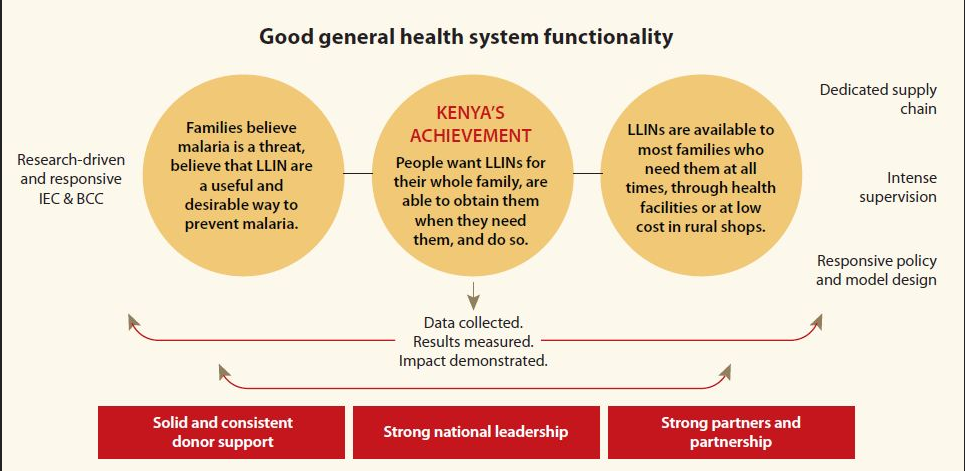
This 2-page brief, published by Roll Back Malaria, shares the experience and lessons learned in Kenya from the country’s strategy of continuous LLIN distribution to prevent malaria. According to the brief, continuous distribution systems are a crucial complement to free distribution campaigns, maintaining the coverage that campaigns build. At the core of success of the distribution systems, led by Kenya’s Division of Malaria Control (DoMC) is that all donors and partners support the principal of one strategy, one co-ordinating body, and one monitoring and evaluation plan. The brief also credits a strong communication programme with mobilising community support for the system.
The brief outlines several important aspects of the national strategy that contribute to its success. While the DoMC includes training on LLIN distribution as part of their standard midwife training or malaria refresher trainings, they have devolved responsibility for maintaining training levels to PSI/Kenya, which does this in collaboration with DoMC personnel. PSI/Kenya uses a flexible approach to training, with no set training course in place. Training focuses on practical needs, evolving issues, and changes in the system.
Along with a dedicated supply chain, intense supervisions is cited as a factor of success, as well as a bonus system built into the social marketing of nets. PSI/Kenya field staff are eligible for monthly bonuses based on the numbers of LLINs turned over, coverage of LLINs in the intended outlets in their area, and absence of stock-outs. This helps ensure that the socially marketed nets are being sold in the right places for the right prices.
District and health facility staff consider community support a major reason for the success of the system; the strong communication programme undertaken by the DoMC in partnership with PSI/Kenya created awareness of and respect for the threat of malaria. This means people want to obtain LLINs through the distribution system, and let district authorities know of instances of theft or sale of "free" LLINs in shops. Also, community members take part in groups such as community management committees, which support health facility operations. Whilst the programme is committed to "one strategy," the Kenya experience shows that adapting programme approaches based on evidence and the changing environment is important to success.
In addition, strong leadership ensures coherent co-ordination of a solid partnership with consistent donor support. According the brief, the strength and vision of the DoMC underpins the success of their continuous distribution model. The DoMC works with a solid and focused partnership of two key donors, the Department for International Development (DfID) and the United States Agency for International Development (USAID), and a dedicated implementing partner (PSI/Kenya) that works closely with the private sector and some grass-roots community-based organisations. The partnership is broad in that it crosses sector boundaries, but it is crucially centred on a few strong, dedicated, and responsive partners. Lastly the brief credits a relatively supportive and well functioning health system environment for the success of the distribution systems.
Roll Back Malaria newsletter, March 2012 on May 12 2012.
- Log in to post comments