










































Facebook Pages, the "Disneyland" Measles Outbreak, and Promotion of Vaccine Refusal as a Civil Right, 2009-2019
The George Washington University (Broniatowski, Johnson, Velasquez, Leahy, Restrepo); University of Maryland (Jamison, Quinn); Johns Hopkins University (Dredze)
"[S]ome have raised concerns that the COVID-19 'infodemic' could trigger vaccine refusal....Public health communicators must therefore attend to rationales for vaccine refusal and how this misinformation might affect real-world behaviors."
Rationales for vaccine refusal vary widely, though they appear to be coalescing around a common narrative that emphasises civil rights and freedom from elitist government overreach. Historically, rationales have been associated with different social groups; social media seem to reflect this community structure, with specific Facebook pages corresponding to these audiences. Facebook can be used to spread health-related information and misinformation quickly and widely, affecting public discourse and, possibly, behaviour. This study examined how the discourse of vaccine opponents on social media has changed over time.
For the study, researchers examined more than 250,000 posts on 204 Facebook pages expressing opposition to vaccines between October 2009 and October 2019. They conducted 3 analyses:
- Categorised the pages into 5 high-level non-mutually-exclusive content categories and measured the volume of posts in each category. Findings: Out of the 204 Facebook pages in the sample, 90 (44%) were categorised as "civil liberties", 90 (44%) as "safety and efficacy", 61 (30%) as "conspiracy theories", 16 (8%) as "alternative medicine", and 7 (3%) as "morality".
- Described the topics of discourse within each page type over time and tested the hypothesis that pages in each category preferentially shared posts reflecting an underlying group identity. Findings:
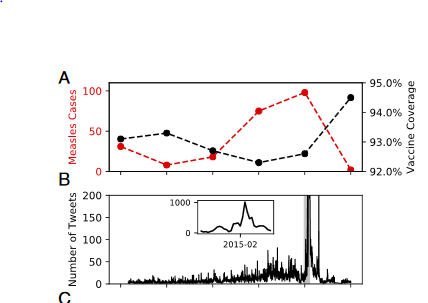
- Compared with previous months, overall monthly post volume increased during the period between January 2015 (the "Disneyland" measles outbreak - see Related Summaries, below) and March 2016. A second increase occurred in the period between April 2016 (the release of Vaxxed: From Cover-Up to Catastrophe, an American pseudoscience propaganda documentary film directed by discredited anti-vaccine activist Andrew Wakefield) and December 2018. This second increase seems to have occurred in pages promoting "civil liberties"; by contrast, post volumes in other pages decreased slightly. Finally, compared with the period between April 2016 and December 2018, a statistically significant increase occurred in January 2019 (the 2019 United States (US) measles epidemic). These changes cannot be attributed to linear increases in the overall Facebook user base.
- The monthly share of posts pertaining to safety and efficacy ("immunity" in the figure above) decreased overall, which coincided with the "Disneyland" measles outbreak and the launch of Vaxxed. By contrast, the share of posts pertaining to civil liberties has grown overall, with discrete increases associated with both the 2015 and 2019 measles outbreaks but a decrease in between. These changes are largely attributable to posts opposing vaccine mandates ("totalitarianism" in the figure above), which follow the same temporal/annual pattern. Furthermore, there were discrete increases in posts advocating political mobilisation ("politics" in the figure above), again following the same temporal/annual pattern.
- Measured whether content across page types was coalescing over time. Findings: Pages categorised as promoting civil liberties and conspiracies posted statistically significantly more content reflecting their corresponding topic categories than did other pages. Each Facebook page category is hosting increasingly similar content. For example, pages pertaining to safety concerns contained equal proportions of posts about safety concerns as those that did not pertain to safety concerns.
Per the researchers, this analysis reveals that the vaccine opponent discourse has increased in volume and evolved over time, with 3 distinct phases:
- Vaccine opposition becomes mainstream: The "Disneyland" measles outbreak brought attention to mainstream vaccine opposition and sparked a national (US) debate and the enactment of legislation to curb personal belief exemptions in California. During this period, the volume of posts on all vaccine opponent pages increased, and civil liberties discourse, in particular, became widespread.
- Popular media spokesmen target civil liberties pages: The launch of Vaxxed coincided with an increase in posts to non-(US)-state-specific civil liberties pages. However, the proportion of civil liberties topics discussed decreased whereas the proportion of posts about the movie increased. This suggests that these pages may have been used as vehicles to disseminate content advertising the movie, possibly having established a linkage between the civil liberties discourse and the personalities (e.g., Andrew Wakefield) driving this movie's agenda.
- Civil liberties pages promote state-level political mobilisation: The year 2019 gave rise to a sharp increase in posts to pages mobilising Facebook fans for political purposes. By contrast, discussion of safety and efficacy has decreased, suggesting that vaccine opponents increasingly oppose vaccination as a matter of political principle rather than because of any particular concern about harms.
In short: "Given the shifting rationales for vaccine refusal, a 'civil liberties' framing fundamentally recontextualizes vaccination, making it into a value-laden political issue, rather than a debate over scientific or medical facts." Lead author David A. Broniatowski said in an interview: "However, this is a case where one person's exercise of that freedom can hurt everyone else."
In light of the fact that "Policymakers should expect increasing attempts to alter state legislation associated with vaccine exemptions, potentially accompanied by fiercer lobbying from specific celebrities," the researchers suggest that:
- "Public health agencies and advocates must...build strong relationships with state policymakers so that they may take an active stance when proposed laws or exemptions would further threaten the public's health.
- We should engage in "sustained research into effective messages for communicating fact-based rationales for vaccination that are nevertheless targeted and tailored. These messages must be responsive to the contextual factors, specific values, and gists motivating vaccine refusal."
American Journal of Public Health 2020;110:S312–S318. https://doi.org/10.2105/AJPH.2020.305869 - sourced from "Researchers Found Anti-Vaccination Discourse on Facebook Increased in Volume over the Last Decade, and Increasingly Emphasizes Civil Rights", Knight Foundation, November 16 2020 - accessed on December 1 2020.
- Log in to post comments