










































FAO country programme demonstrates relevance in addressing development issues in the Kyrgyz Republic
Author: James Ayodele - A recent report by the [Food and Agriculture Organization (FAO)] Office of Evaluation says that the FAO’s programme in the Kyrgyz Republic has been comprehensive and has largely addressed relevant development goals and key development issues. Most of the initiatives have enjoyed a high degree of ownership by beneficiaries and are appreciated by government counterparts and donors, but a more comprehensive analysis of the rural context and a greater focus on value chains would bring greater results, the report adds.
Conducted in 2016, the evaluation assessed FAO’s contribution to the country through its Country Programming Framework 2015–2017, with thematic orientation of the earlier work for 2010-2015.
Stakeholders interviewed said FAO’s cooperation was valuable because it addressed priority issues and flexibly responded to emerging needs.
In response to the National Sustainable Development Strategy, FAO strengthened the efficiency and effectiveness of regulations by supporting policy and strategy formulation in agriculture, food security, forestry, land, and natural resource management. In partnership with other UN agencies and under the aegis of the Prime Minister’s office, a national food security and nutrition strategy and related information system was developed.
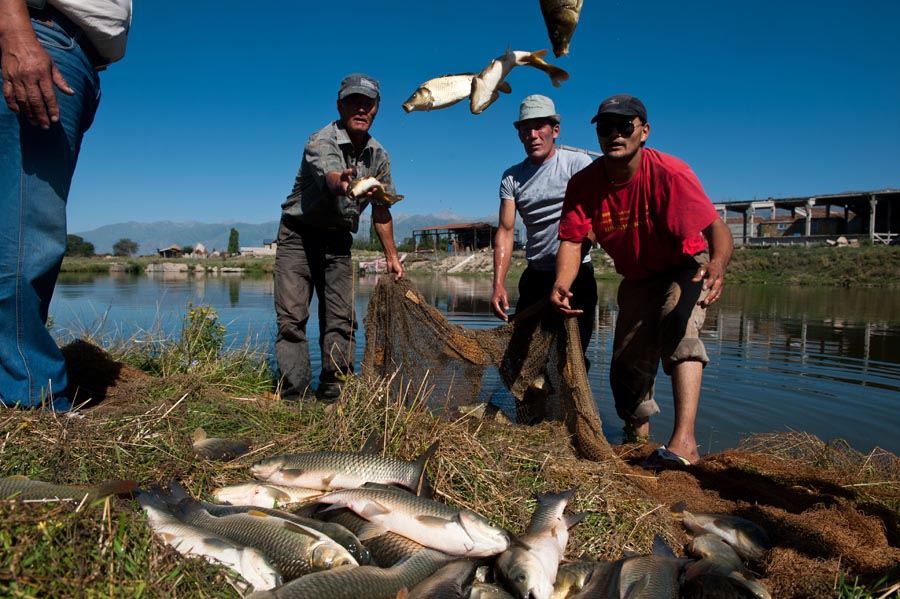
FAO’s support for science and research in the country was highly appreciated. The government particularly acknowledged the research on aquaculture in Issyk Kul Lake, which led to the lifting of the moratorium on fishing in the lake. It recognised the support for the adoption of a global methodology for forestry assessment and monitoring and the training of employees on implementation, which led to the development of a new National Forest Management Assessment Plan.
Stakeholders perceived FAO as a key facilitator in evidence-based decision-making, consensus building and technical capacity strengthening. They appreciated its coordination role in locust control and the national programme on food security and nutrition, which they said has contributed to stronger cooperation among line ministries and multilateral agencies and substantial increase in the technical capacity of the State Inspection of Veterinary and Phytosanitary Security.
Most of the livestock development projects have strengthened capacity nationally and at the local level. For instance, laboratory capacities were strengthened to conduct diagnostic tests that were previously unavailable. The support for establishment of an animal identification and traceability system was especially valued by the government and private sector.
Stakeholders also perceived the support for fisheries and aquaculture research capacity and infrastructure as a unique opportunity. They said it has contributed to a growing interest in fish farming and a 20 percent increase in fish consumption among project beneficiaries in the last five years. Farmers’ knowledge and skills in growing trout and carp cultures and on-farm aqua-feeds production also increased.
“People now understand that fish is very good for health … we eat fish more frequently now,” said one of the beneficiary fish farmers.
The investments in reforestation and crop diversification were found to be effective; they have strengthened the capacity of local forestry institutes and specialists to implement new methods. The seed development programmes have contributed to increasing the resilience of small-scale farmers to the impact of soaring food prices by improving capacity and institutional environment for seed production.
The evaluation however notes that although FAO development initiatives in the Kyrgyz Republic have enjoyed high levels of ownership and appreciation, some projects and sectoral policy initiatives were reportedly less successful, especially those that were less context-specific.
It notes that some FAO global technical information materials on livestock, agriculture and food security, which were adopted and disseminated for outreach purposes in the country, would have produced greater impact if they were systematically translated into the Kyrgyz language.
It notes also that the lack of robust monitoring and evaluation systems limited the availability of data needed to verify and attribute the results.
The evaluation recommends that, building on the success of its policy, capacity development and field interventions, FAO should focus its cooperation in the country on scalable programmes, which by design include a value chain approach and adequate consideration for gender equity and monitoring and evaluation.
It recommends that FAO should focus on addressing higher-level objectives such as contributing to equitable and inclusive rural poverty reduction and the competitiveness of the agri-food sector by strengthening the analytical base of its projects and policies and seeking to enhance its partnerships with relevant policy and field-level actors.
- Log in to post comments